
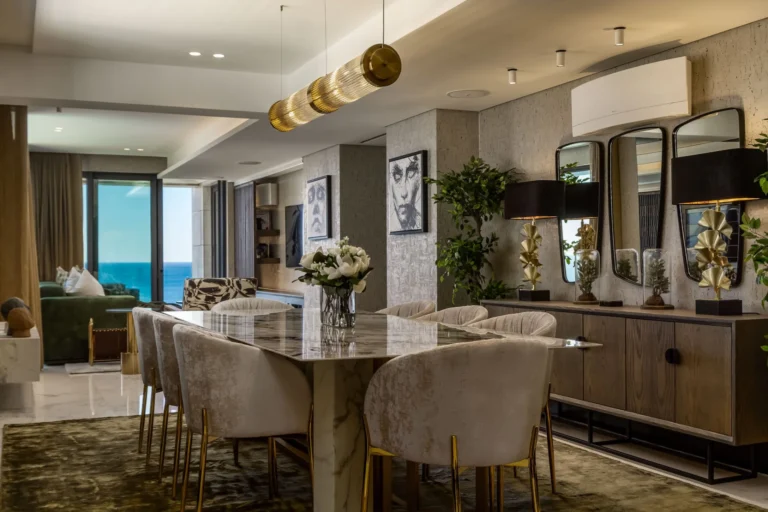
High-end interior design in Calgary is often misunderstood. Most homeowners assume luxury comes from expensive finishes, statement lighting, or oversized custom features. But if you’ve ever walked through a home filled with premium materials that still felt awkward or unfinished, you’ve already seen the difference between expensive and truly well-designed.
You can have a relatively modest budget and still create something that feels calm, cohesive, and elevated. At the same time, it’s possible to spend significantly more and end up with a space that feels disjointed or overly busy. That difference comes down to decisions that most people don’t immediately notice, but feel as soon as they’re in the space. Those decisions happen early, and they carry through everything that follows.
High-End Interior Design Starts With Layout, Not Finishes
The easiest way to tell if a home will feel high-end is to look at the layout before anything else is added. If the flow feels awkward or forced, no material choice will fix that later. You might not be able to immediately explain why the space feels off, but it usually comes down to how rooms connect, how people move through them, and whether the layout supports daily use. A well-planned layout creates a sense of ease that you don’t have to think about.
This is one of the reasons designers spend so much time resolving layout early in the process. When that foundation is strong, everything else builds on it naturally instead of trying to compensate for it. It also aligns with broader industry guidance, where organizations like the Canadian Home Builders’ Association emphasize planning and coordination as key factors in successful renovations.
Consistency Matters More Than Standout Features for High-End Interior Design
A lot of homeowners focus on creating one or two standout moments in a home. A bold kitchen, a dramatic light fixture, or a feature wall can feel like the centerpiece of the design. But what actually makes a space feel elevated is consistency from one area to the next. Materials, tones, and proportions need to relate to each other so the home feels cohesive instead of segmented.
When that consistency is missing, even high-end elements start to compete with each other. The space feels busy, and nothing has room to settle. This is where restraint becomes more important than impact. Michael often explains this to clients in terms of what you choose not to include. Michael Anderson, lead designer at HAUS Interiors says, “a truly high-end space is less about what you choose to put in and more about what you choose to leave out. Restraint allows the materials and proportions to work together, creating a quiet consistency that feels far more elevated than any single standout feature.”
Scale and Proportion Shape the Entire Experience
One of the biggest differences between a home that feels high-end and one that doesn’t comes down to scale. Elements that are slightly off in size or proportion can quietly affect how the entire space is experienced. A kitchen island that is too small or too large changes how people gather and move around it. Lighting that doesn’t match the ceiling height or room size can throw off the balance of the space.
These are not dramatic mistakes, but they are noticeable over time. They affect how comfortable the space feels and how naturally it functions. This is also why copying designs from other homes rarely works as expected. What looks right in one space may not translate at all in another because the proportions are completely different.
Material Choices Are About Restraint and Longevity
There is a common assumption that more expensive materials automatically create a higher-end result. In practice, using too many materials, even high-quality ones, can make a space feel less refined. A home that feels elevated usually has a more controlled palette, where materials are chosen carefully and used consistently. That restraint creates a sense of clarity that people interpret as quality.
Material selection is also tied to how the home performs over time. Some finishes look good initially but wear poorly, which quickly affects how the space feels. Others develop character and maintain their integrity through daily use. This is why long-term thinking matters, which is explored in more detail in How Designers Create Timeless Interiors Instead of Trendy Ones, where decisions are made based on how a space will age rather than how it looks on day one.
Lighting Is What Brings Everything Together
Lighting is one of the most underestimated elements in creating a high-end feel. Even a well-designed space can fall flat if the lighting is too harsh or too uniform. On the other hand, thoughtful lighting can elevate a simple space by adding depth and variation. It allows the home to feel different depending on the time of day and how it is being used.
This is why lighting needs to be layered and planned intentionally, not just selected at the end. The Illuminating Engineering Society provides detailed guidance on how lighting affects both comfort and visibility, which reinforces how critical it is to consider lighting as part of the overall design rather than an afterthought. Michael often describes lighting as one of the biggest contributors to how a space is experienced rather than how it looks. Michael says, “we don’t just design lighting for visibility; we design it to shape the experience. Lighting is the emotional layer of a home, controlling the atmosphere and dictating how a space is felt, rather than just how it is viewed.”
High-End Spaces Feel Calm, Not Busy
One of the most consistent characteristics of a high-end home is how it feels when you’re in it. There is a sense of calm that comes from clarity and intention. Nothing is competing for attention, and the space doesn’t feel like it’s trying to prove anything. That calmness is what people often describe as luxury, even if they can’t immediately explain why.
That feeling is the result of editing. Not every idea needs to be included, and not every feature needs to stand out. The decisions that remain are deliberate, and everything else is removed. This is where the difference between decorating and designing becomes most noticeable.
The Details Are Subtle, But They Matter
A lot of what makes a home feel high-end is not immediately visible. It shows up in how materials meet, how cabinetry aligns, and how transitions between spaces are handled. These details are not things most people can point to directly, but they influence how the space is perceived as a whole. When they are done well, everything feels cohesive without drawing attention to itself.
These details are also the result of planning, not last-minute adjustments. They require coordination across multiple elements of the design, which is why they are difficult to achieve without a clear process. If you want to understand how to approach a project with that level of clarity, How to Prepare for Your First Interior Design Consultation outlines what to think through before starting so those decisions can be made intentionally from the beginning.
What a High-End Home Actually Feels Like
When a home is designed well, the experience is consistent rather than dramatic. You move through the space without friction, and everything feels like it belongs. The lighting adapts to how you’re using the room, and the materials continue to feel right over time. Nothing stands out for the wrong reason, and nothing feels unresolved. Michael often describes this as the difference between a home that looks finished and one that actually feels finished. Michael says, “the difference between a home that looks finished and one that feels finished is complete cohesion. When all the elements, from the layout to the lighting, are resolved and working together, you get a sense of effortless frictionlessness that is the ultimate sign of quality design.”
Ready to Create a Home That Actually Feels Elevated
If you’re planning a renovation and want the result to feel cohesive rather than pieced together, the difference comes down to how decisions are made early in the process. Layout, materials, lighting, and proportion all need to be considered together so the home works as a complete environment. When those decisions are made intentionally, the result feels calm, functional, and elevated in a way that lasts. If you want to approach your renovation with that level of clarity, you can schedule a consultation.